 Anhui Xingtong Technology Co., Ltd

Steel street light poles are an important structural component of modern outdoor lighting systems. While LED luminaires determine the lighting performance, the pole provides the mechanical support required to safely install the lighting equipment at the specified height and position.
For municipal roads, highways, residential streets, commercial areas, parking lots and solar street lighting projects, selecting a suitable steel pole is essential for long-term reliability.
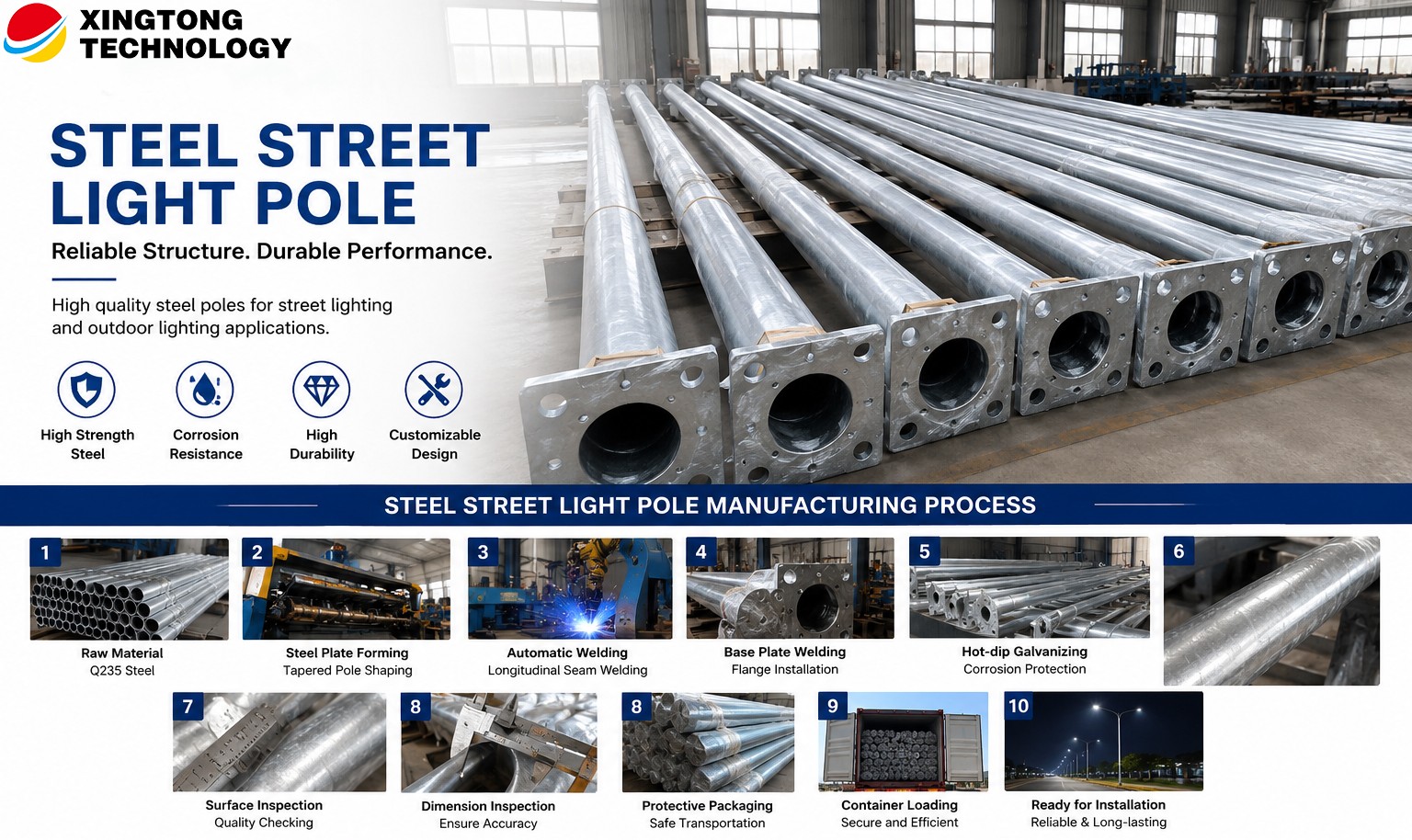
This article introduces the main manufacturing considerations for steel street light poles, from structural design and steel forming to surface treatment, quality inspection and final packaging.
1. Why Is the Street Light Pole Important?
A street light pole is more than a simple support structure.
During operation, the pole needs to withstand:
- The weight of the LED luminaire
- Wind pressure
- The weight of brackets and accessories
- Outdoor environmental exposure
- Long-term mechanical loads
- Transportation and installation requirements
For this reason, the pole should be designed according to the requirements of the specific lighting project.
Pole height, material thickness, diameter, shape, arm configuration, foundation connection and surface treatment can all influence the final performance of the lighting system.
2. Steel Material Selection
Steel is widely used for outdoor lighting poles because it provides a good combination of mechanical strength, manufacturability and cost efficiency.
For many street lighting applications, Q235 steel is a commonly used material.
At Xingtong Technology, our steel pole product range includes galvanized Q235 steel poles for street lighting and other outdoor applications. Available configurations can be customized according to project requirements.
Depending on the project, customers may specify:
- Pole height
- Steel grade
- Wall thickness
- Pole diameter
- Pole shape
- Single-arm or double-arm configuration
- Base plate dimensions
- Bolt-hole arrangement
- Surface treatment
- Color and coating requirements
3. Tapered Steel Pole Structure
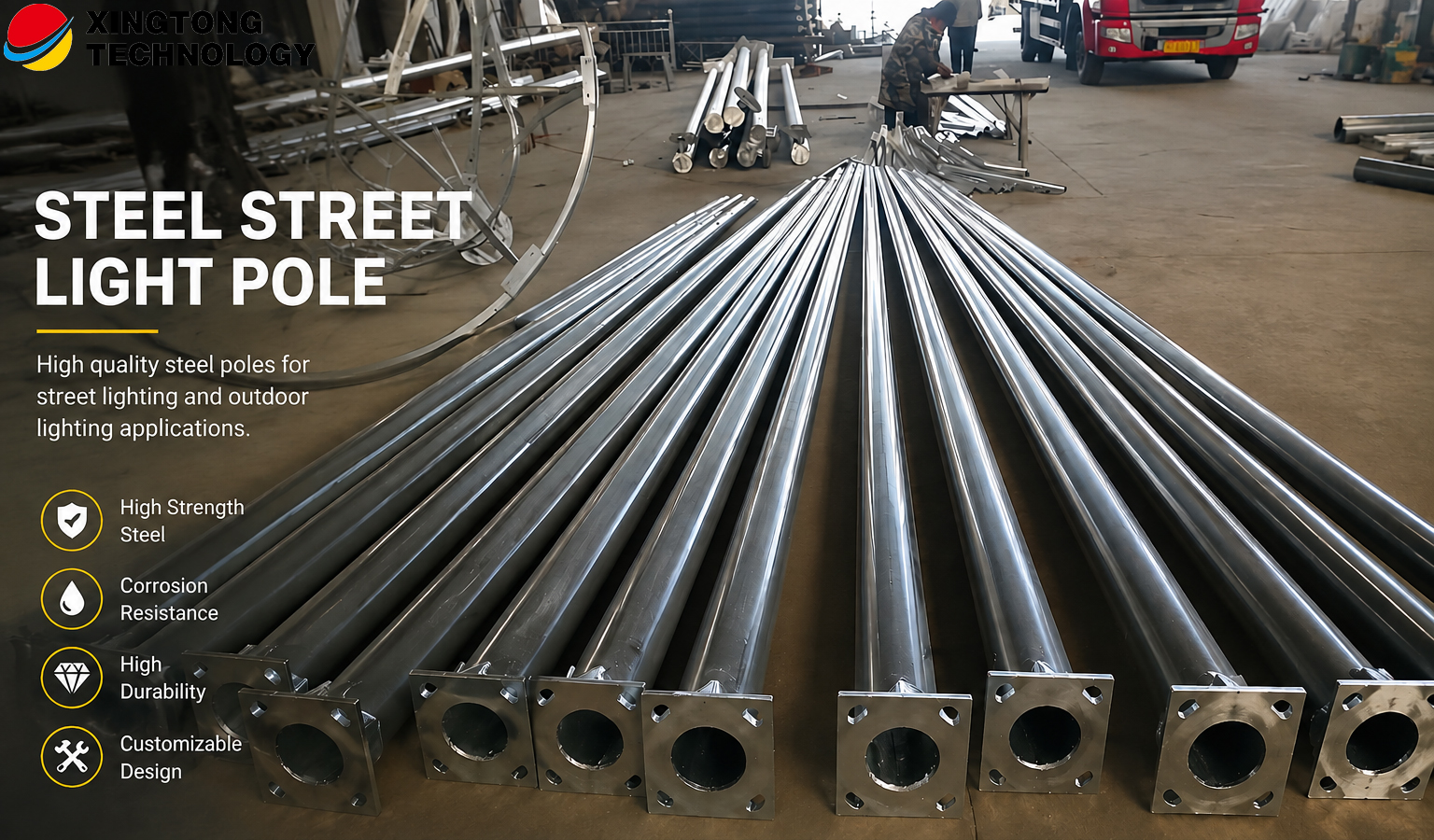
One important feature visible in our production video is the tapered pole structure.
A tapered pole gradually changes in diameter from the bottom toward the top. This design provides a practical balance between structural performance, material usage and overall appearance.
Compared with a simple constant-diameter structure, a tapered pole can be designed to provide an appropriate distribution of material along the pole body.
The exact dimensions and wall thickness should be determined according to the required pole height, luminaire configuration, wind load and local project standards.
4. Pole Body Forming and Welding
During manufacturing, steel sheets are processed and formed into the required pole geometry.
The main production processes may include:
- Steel plate preparation
- Cutting according to engineering drawings
- Plate forming
- Pole body shaping
- Longitudinal welding
- Welding of the base plate
- Installation of brackets or accessories
- Surface treatment
- Quality inspection
- Protective packaging
The welding process is particularly important because the longitudinal weld is one of the critical structural areas of a steel lighting pole.
Consistent welding quality helps ensure the mechanical integrity of the finished pole.
5. Base Plate and Foundation Connection
The bottom of the pole is normally connected to the concrete foundation through a base plate and anchor bolts.
The base plate transfers the loads from the pole into the foundation.
Therefore, the following dimensions should be considered carefully:
- Base plate thickness
- Plate dimensions
- Anchor bolt diameter
- Bolt-hole spacing
- Number of bolt holes
- Pole-to-base connection
- Foundation design
For customized municipal projects, the base plate and bolt-hole configuration can be manufactured according to the customer's engineering drawings.
6. Galvanizing and Surface Protection
Outdoor lighting poles are exposed to rain, humidity, sunlight and other environmental conditions.
Therefore, corrosion protection is an important part of the manufacturing process.
Hot-dip galvanizing is widely used for steel lighting poles because it provides a protective zinc coating over the steel surface.
Xingtong Technology's existing steel pole specifications include hot-dip galvanized treatment, with a listed coating thickness of approximately 80 μm for the relevant product configuration. Actual coating requirements can be adjusted according to project specifications.
A suitable surface protection system can help extend the service life of the pole and reduce maintenance requirements.
7. Quality Control Before Delivery
Quality control should not only focus on the appearance of the finished pole.
For street lighting projects, important inspection points may include:
Dimensional Inspection
Check:
- Overall pole length
- Bottom and top diameter
- Wall thickness
- Base plate dimensions
- Bolt-hole spacing
- Arm dimensions
Welding Inspection
The welded areas should be inspected for:
- Weld continuity
- Visible cracks
- Welding defects
- Surface quality
- Structural integrity
Galvanizing Inspection
The galvanized surface should be checked for:
- Coating uniformity
- Surface defects
- Coating thickness
- Areas with insufficient coverage
Appearance Inspection
The finished pole should have an acceptable surface finish without significant deformation or damage.
8. Protective Packaging for Transportation
Street light poles can be long and relatively difficult to transport.
Proper packaging is therefore important, particularly for international export projects.
As shown in our latest production video, the finished poles are individually protected before transportation.
Protective packaging can help reduce:
- Surface scratches
- Impact damage
- Friction during transportation
- Damage to the galvanized surface
For export orders, packaging methods can be adjusted according to the transportation method, container loading requirements and customer requirements.
9. Custom Street Light Poles for Different Projects
Different lighting projects require different pole configurations.
For example:
Municipal Road Lighting
Typical requirements may include:
- 6–12 m pole height
- Single or double arms
- Galvanized steel construction
- Customized foundation connection
- LED street light installation
Solar Street Lighting
Solar street light poles may need additional consideration for:
- Solar panel mounting
- Battery system configuration
- Luminaire weight
- Wind loading
- Bracket design
High Mast Lighting
High mast applications generally require more detailed structural calculations because of the increased pole height and wind exposure.
Smart City / Multifunctional Poles
Multifunctional poles may integrate:
- LED lighting
- CCTV cameras
- Communication equipment
- Sensors
- Wireless equipment
- Other smart-city devices
Xingtong Technology also provides steel pole solutions for street lighting, high-pole lighting, multifunctional applications and CCTV monitoring.
10. Choosing the Right Steel Street Light Pole
When purchasing a steel street light pole, price should not be the only consideration.
We recommend evaluating the following factors:
1. Pole height
The required mounting height depends on road width, lighting layout and luminaire photometric performance.
2. Wind load
The pole should be designed for the local wind conditions and project requirements.
3. Luminaire size and weight
Larger LED luminaires can create additional wind-loading requirements.
4. Steel thickness
Wall thickness should be selected according to the structural design rather than simply choosing the thinnest option.
5. Surface treatment
Galvanizing or another suitable corrosion-protection system should be selected according to the local environment.
6. Foundation connection
The base plate and anchor bolt arrangement should match the engineering design.
7. Transportation
Pole length, section design and packaging should be considered before placing a large export order.
11. Xingtong Technology Steel Pole Manufacturing
Anhui Xingtong Technology Co., Ltd. provides steel pole solutions together with LED street lighting and solar lighting systems.
Our current steel pole product range includes Q235 galvanized steel poles, with different heights, thicknesses, shapes and arm configurations available according to project requirements. The company's listed product range includes approximately 4 m to 12 m pole heights and 2.5–6.5 mm steel thickness options, depending on the model and application.
As a lighting solution supplier, Xingtong Technology can provide customers with coordinated solutions covering:
- LED street lights
- Solar street lights
- Steel street light poles
- Lighting brackets
- Solar lighting systems
- Municipal road lighting solutions
The company also lists street lighting poles and municipal road lighting among its product and project categories.
12. Conclusion
A reliable street light pole is an important foundation for a long-lasting outdoor lighting system.
From steel material selection and pole forming to welding, galvanizing, dimensional inspection and transportation protection, every manufacturing step can affect the final performance of the pole.
For municipal lighting contractors, distributors and project developers, selecting a pole manufacturer capable of providing customized dimensions, suitable surface treatment and project-specific structural configurations can help reduce installation and maintenance risks.
At Anhui Xingtong Technology Co., Ltd., we provide customized steel street light pole solutions for different outdoor lighting applications.
If you have a street lighting project and need customized pole dimensions, drawings or a quotation, contact our team for a project-specific solution.