 Anhui Xingtong Technology Co., Ltd.

Choosing an off-grid solar system starts with understanding what the site needs to power, how much electricity it uses each day, and how long it must operate without sufficient sunlight. Inverter power, battery capacity and solar-array size each answer a different part of this requirement.
For distributors, installers and project buyers, separating these three specifications helps make quotations easier to compare and system requirements clearer.
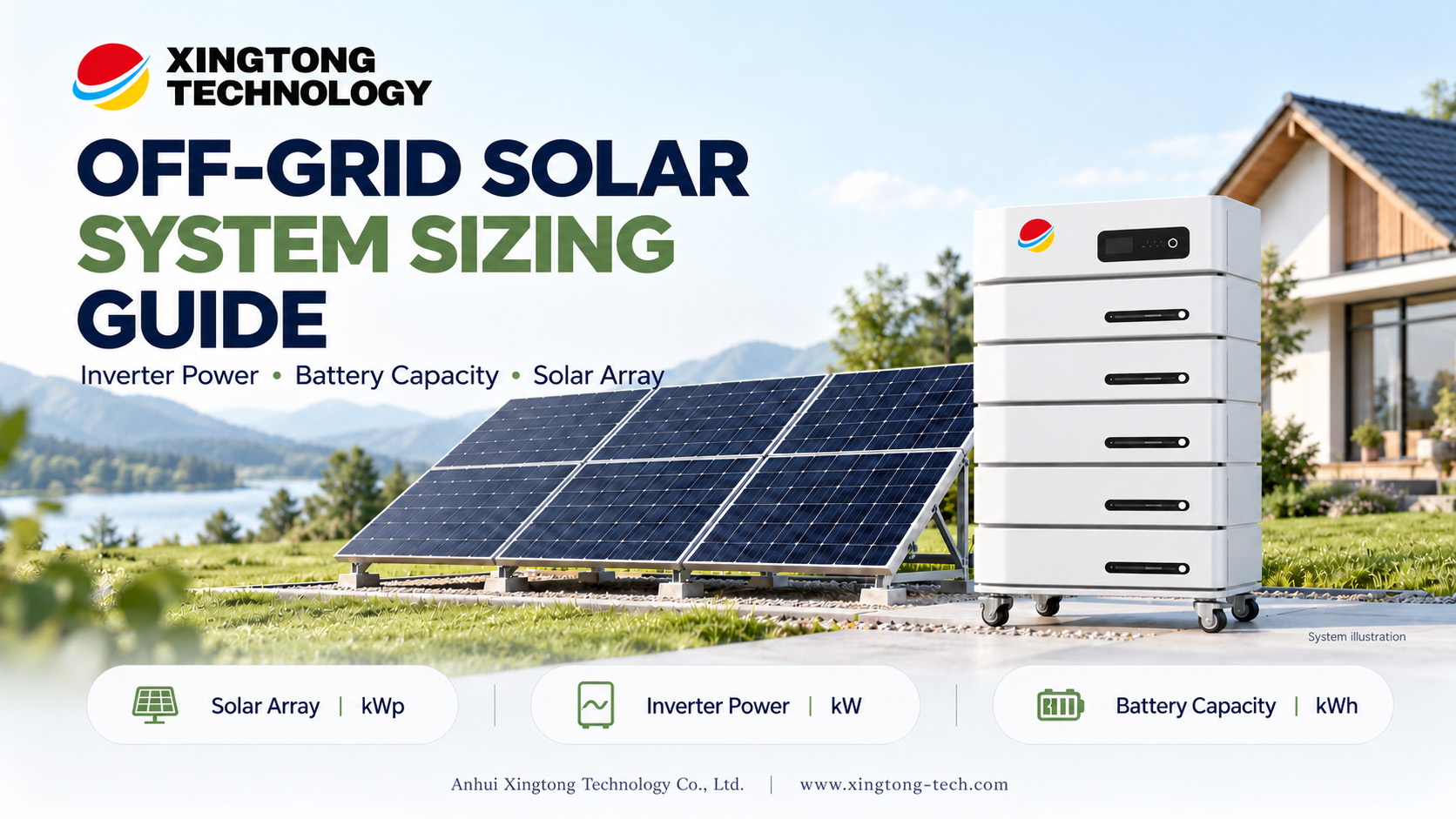
Understand kW, kWh and Solar-Array Capacity
The inverter’s rated AC output, expressed in kilowatts (kW), determines the operating load it can supply within its specified limits. Battery capacity, expressed in kilowatt-hours (kWh), describes stored energy.
Solar-array capacity is a separate specification, commonly expressed in kWp. A system with a 5.5kW inverter does not necessarily have a 5.5kWp solar array.
Adding battery modules increases stored energy within the system’s supported limits. It does not automatically increase inverter output.
Start with the Load List
List the appliances, their rated power, estimated operating hours and which items will run together. Identify essential loads separately from equipment that can be switched off when stored energy is limited.
For example, a constant 1kW load running for five hours consumes 5kWh before system losses. This is an illustrative calculation, rather than a runtime promise for a particular battery.
Pumps, compressors and air conditioners also require a starting-load assessment. Their startup demand must be checked against the selected inverter’s surge capability.
Select Battery Capacity for the Required Operating Period
Battery sizing should consider the energy required overnight and during periods of low solar production. The nameplate capacity alone does not establish the energy available to AC appliances: operating limits, conversion losses and the selected reserve setting also matter.
Xingtong Technology’s XT-PV-OFF-AIO system uses 5.12kWh LiFePO4 battery modules, with the following listed configurations:
| Battery Modules | Nominal Storage Capacity |
|---|---|
| 2 | 10.24kWh |
| 3 | 15.36kWh |
| 4 | 20.48kWh |
| 5 | 25.60kWh |
| 6 | 30.72kWh |
The product page describes a standard 5.5kW off-grid inverter configuration. Other inverter options within the advertised 3–10kW range require configuration confirmation.Xingtong Technology
Match the Solar Array to the Site
Solar panels must supply daytime consumption and provide sufficient energy for battery charging. Storage allows solar energy generated during daylight to be used later, but a larger battery alone does not increase solar generation.Department of Energy
Assess local sunlight, seasonal variation, shading and available installation space. The final panel quantity and string design must also match the selected inverter’s PV input limits.
Prepare the Information Needed for a Proposal
Before requesting a quotation, provide:
- Installation location and required AC voltage and phase.
- Appliance list, simultaneous operating load and motor-starting requirements.
- Daily energy consumption and required operating time without solar input.
- Roof or ground installation details, available area and shading conditions.
- Any requirement for generator support or future expansion.
Anhui Xingtong Technology Co., Ltd. can review these requirements and propose a suitable system configuration.
Explore our off-grid solar PV system with LiFePO4 battery storage, or send your project details to info@xingtong-tech.com.